
Hidden motivations behind canine toy-burying antics.

If you’ve ever looked down to find your dog’s favorite squeaky toy tucked inside your shoe, you’re likely to wonder what on earth is going on. Dogs do this more often than we imagine and it’s not random mischief. There are instincts, emotions and learned habits all layered into the act of hiding toys in peculiar places. Understanding why your dog does this lets you see their behaviour with a fresh lens and respond in a way that supports both them and your home environment.
1. Dogs inherit a hoarding instinct from their wild ancestors.

Domesticated dogs carry traits from ancestral canines, and according to the American Kennel Club many hide toys because the instinct to hoard or guard valuable items still lives in them (turn0search0). In your home shoe rack your dog may see the shoes as a den or store space and choose them to stash a prized toy. This stems from survival strategies of storing surplus in concealment and now shows up in living rooms rather than forests.
2. Your dog might be marking possessions to claim them as theirs.

If hiding toys gives your dog a sense of ownership over them it also signals to other pets or even humans that “this is mine”, as discovered by guardians of canine behavioural science reported by Green Matters (turn0search16). When your dog drops a toy into your footwear he or she may be declaring territory or simply ensuring no one else takes it. That action is less about you and more about protecting valued items.
3. The behaviour can express anxiety or stress requiring relief.

Sometimes dogs stash toys to cope with tension in their environment, as stated by All4Paw (turn0search18). If your dog senses change—new schedule, less playtime, unfamiliar visitor—they may create safe spaces by hiding favourite items. Your shoes become part of a comforting zone and the toy becomes part of their coping mechanism.
4. Hiding a toy may reflect your dog’s drive to initiate play with you.

When your dog relocates a toy into your shoe it can act as a subtle invitation for interaction—placing something in your path so you notice. They may anticipate you reaching for the shoe, discovering the toy, then launching play or retrieval. That transition from hiding to retrieving creates an implicit game and strengthens the bond.
5. Your dog setting up a “hidden treasure” satisfies their innate hunting-and-gathering urge.

More than guarding, some dogs engage in caching behaviour reminiscent of burying food in the wild. Hiding a toy under your shoe or inside footwear becomes a modern version of that instinct—to stash something valuable and revisit it later. Even in a safe home, the old programming drives them to organise, protect and store in subtle ways.
6. The shoe becomes a scent-rich enclosure that appeals to your dog’s olfactory sense.
Your shoes carry your scent and your dog’s scent, making them comfortable containers and meaningful hiding spots. When they place a toy there they’re anchoring the object into a zone that smells familiar and safe. That scent layering turns a shoe into more than footwear—it becomes a repository of connection and comfort.
7. Your dog might use toy-hiding to prevent competition with other pets.
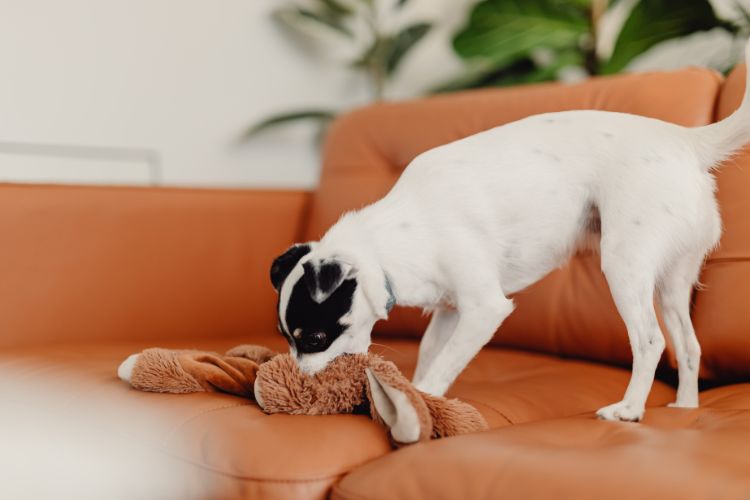
In a multi-animal household the struggle over resources includes toys. By depositing a toy in your shoe your dog may be removing it from the visible field of competition. That behaviour reduces the chance of another pet snatching it, so your dog secures it in a place human-accessible but less contested.
8. Your dog is reinforcing a pattern that gained your attention before.

When you react to the discovery of a toy in your shoe—whether amused, retrieving it, and tossing it back—the behaviour gets reinforced. The act becomes a subtle loop of hiding and seeking, where your response completes the cycle. Your dog learns that the shoe-stash method attracts your interaction, turning it into part of the shared routine.