
The numbers keep circling back to one outcome.

Far beyond the orbit of the moon, a dark object circles the sun on a path that repeatedly crosses Earth’s neighborhood. Each pass brings new calculations, new observations, and new questions that scientists cannot fully close. The numbers shift slightly with time, but not enough to dismiss the concern. Somewhere in the future, a narrow window remains. It is small, distant, and uncertain, yet precise enough that researchers continue watching.
1. Its orbit keeps bringing Bennu uncomfortably close.

Every few years, asteroid Bennu returns to the inner solar system, passing Earth at distances that feel safe but still draw attention. Its path crosses our orbit repeatedly, and each approach invites fresh calculations and concern about how stable that path really is. The timing of these passes is predictable, yet the exact distance can vary slightly with each orbit.
Scientists have identified Bennu as a near Earth object roughly 1,600 feet wide. It approaches Earth about every six years. Each pass is tracked using radar and optical data, refining its orbit. Even slight changes during these encounters can influence where it travels decades from now. These measurements are compared across observatories worldwide. Over time, patterns emerge that guide future projections. Still, no single pass provides complete certainty.
2. A future date keeps appearing in projections.

Among the many possible future paths, one particular scenario continues to surface in long term models. It is not the most likely outcome, yet it appears consistently enough that scientists have assigned it a specific date. This persistence keeps it in focus even as other scenarios fade.
Current projections identify September 24, 2182 as the most significant potential impact window. The probability remains low, estimated at roughly one in several thousand. Still, that date persists in simulations, making it a focal point for ongoing observation and analysis. It emerges from repeated modeling runs. Each update tests whether it remains valid. So far, it continues to hold its place in projections.
3. A narrow gravitational keyhole could redirect everything.

During one of its future close approaches, Bennu may pass through a small region in space that could alter its trajectory. This region, known as a gravitational keyhole, is critical to long term predictions. It represents a precise alignment of position and timing.
If Bennu passes through this keyhole, Earth’s gravity would shift its orbit just enough to set up a later encounter. The keyhole itself is only a few kilometers wide. Missing it entirely would eliminate the risk for that scenario, but passing through it changes everything. These keyholes are mapped years in advance. Their positions depend on earlier orbital conditions. Even slight variations determine whether Bennu enters or avoids them.
4. Planetary gravity continues to reshape its trajectory.

As Bennu travels around the sun, it experiences subtle gravitational pulls from planets, especially Earth and Venus. These forces slightly adjust its orbit during each pass through the inner solar system. Each interaction leaves a measurable imprint.
These adjustments are small but cumulative. Over decades, repeated gravitational interactions can shift Bennu’s position enough to affect future encounters. Scientists must account for these influences in every model, knowing that even minor changes can alter long term outcomes. Planetary alignments vary with time. Each close pass produces a slightly different effect. This adds complexity to long range forecasting.
5. Solar radiation is slowly pushing Bennu off course.

Bennu’s orbit is also influenced by a less obvious force. As it absorbs sunlight and re emits heat, it experiences a tiny push known as the Yarkovsky effect. This force acts continuously as Bennu rotates through sunlight.
Over long periods, this effect can shift Bennu’s trajectory by miles. NASA missions have confirmed that this thermal force is actively altering its orbit. While small in the short term, it becomes significant when projecting the asteroid’s path over more than a century. The effect depends on surface properties. Rotation speed also plays a role. These factors must be measured and updated as new data arrives.
6. Measuring its path requires extreme precision over time.
Kevin Gill
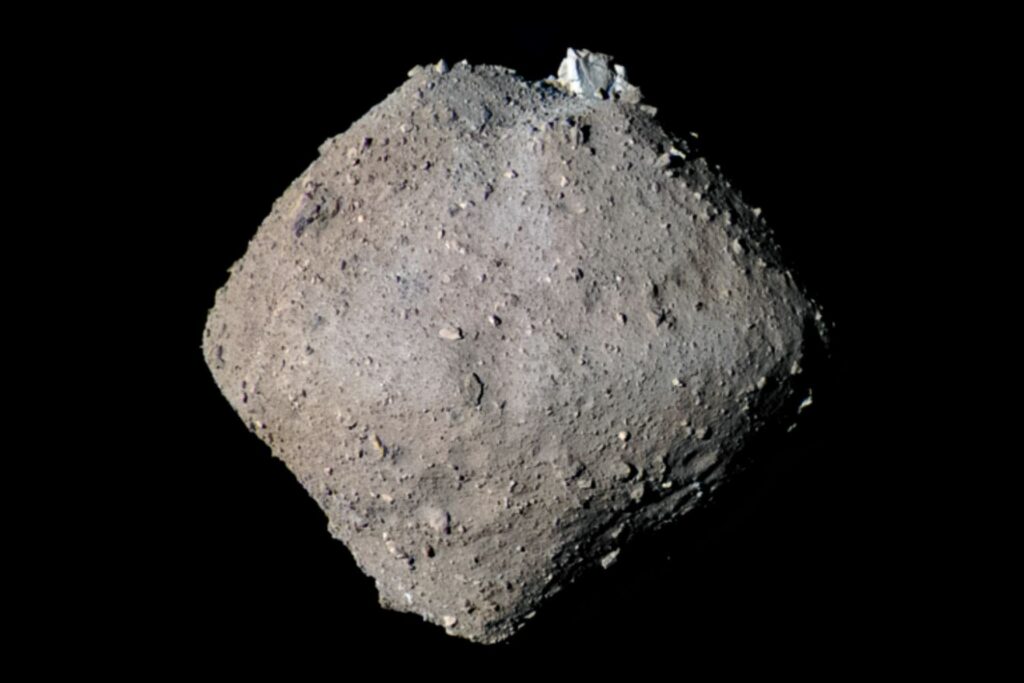
Tracking Bennu involves combining data from telescopes, radar, and spacecraft observations. Each measurement must be extremely precise to reduce uncertainty in future predictions. Observations are repeated over years to confirm consistency.
Even a tiny error in position or speed can expand into a much larger uncertainty over decades. Scientists continuously refine Bennu’s orbit using updated data. Each improvement narrows the range of possible future paths, but it does not remove uncertainty entirely. Radar imaging adds detail during close approaches. Optical tracking fills in gaps between passes. Together, these methods create a clearer but still evolving picture.
7. A direct mission revealed its structure and composition.
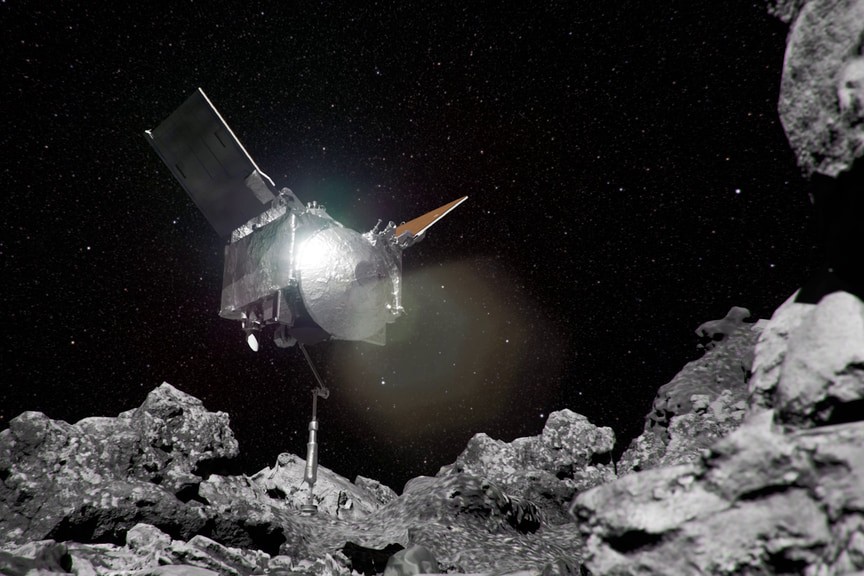
NASA’s OSIRIS REx mission traveled to Bennu and collected samples directly from its surface. The mission provided detailed information about the asteroid’s size, shape, and material. It also mapped the surface at high resolution.
Bennu is not a solid rock. It is a rubble pile, made of loosely held material. This structure affects how it would respond to any deflection attempt. A loose composition could absorb impacts differently than a solid object, complicating potential mitigation strategies. The surface is covered in boulders. Dust and smaller fragments shift easily. These characteristics influence both risk and response planning.
8. A potential impact would release immense energy.

If Bennu were to collide with Earth, the energy released would be enormous. An impact of this size could devastate a large region and create widespread environmental effects. The scale depends on several variables.
Estimates suggest the energy would be equivalent to hundreds of megatons of TNT. The exact consequences would depend on impact location, angle, and speed. Coastal regions, urban areas, and atmospheric effects would all influence the scale of damage. Shockwaves would extend outward. Heat could ignite surrounding areas. Debris could reach the upper atmosphere and affect climate patterns.
9. Scientists are developing ways to change its path.

Researchers are studying methods to alter the trajectory of asteroids like Bennu. These include kinetic impactors that strike the object and gravitational techniques that slowly shift its orbit. Each method relies on careful timing.
NASA has already tested a kinetic impact method on another asteroid, demonstrating that deflection is possible. Applying such techniques to Bennu would require precise timing and coordination. Acting early would be far more effective than waiting until the last moment. Planning must account for uncertainties. Multiple strategies may be combined. Ongoing research continues to refine these options.
10. Continuous monitoring is refining the risk over time.
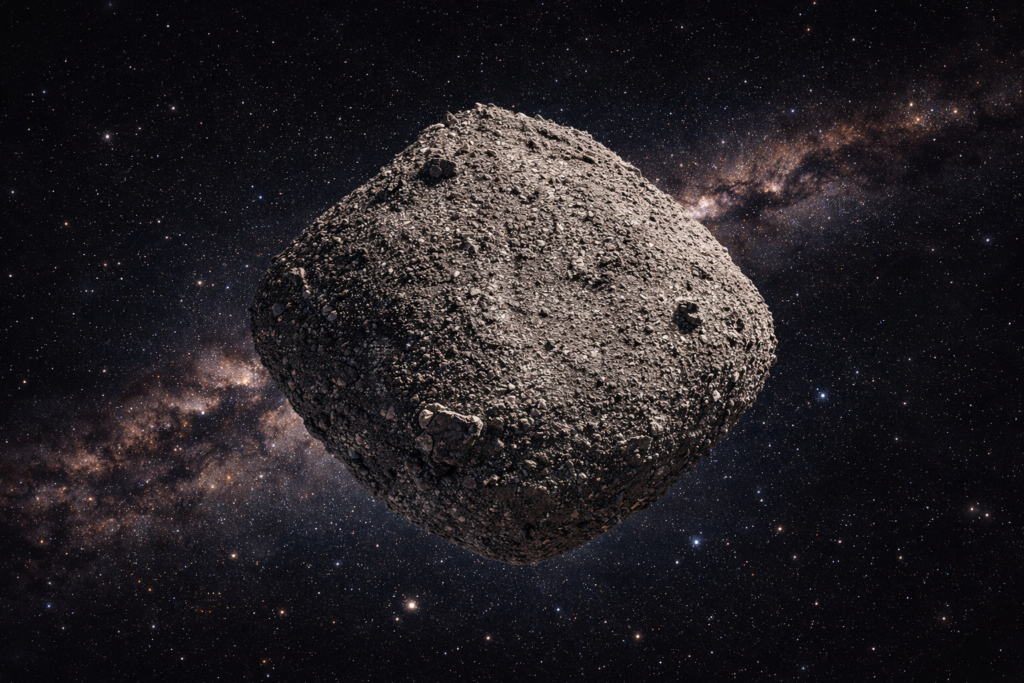
Bennu remains one of the most closely watched asteroids in the solar system. Scientists around the world continue to monitor its orbit and update predictions as new data becomes available. Observations occur during each favorable approach.
Each observation reduces uncertainty slightly, improving long term forecasts. The probability of impact may change as models improve. For now, Bennu remains under careful watch, its future path recalculated again and again as researchers work to understand exactly where it will be in the centuries ahead. New technologies improve tracking accuracy. International collaboration strengthens data sharing. The process continues without a final answer yet.