Top 10 Ocean Predators That Everything Else Avoids

The sea has a hierarchy, and it bites.

©Image license via iStock

The ocean is full of animals that hunt, but a small group rewrites the rules for everyone around them. Some dominate by speed, others by stealth, others by sheer mass and endurance. When these predators enter a bay, a reef edge, or an ice lead, prey do not just hide, they relocate, change feeding times, and sometimes stop making noise altogether. Here are ten predators that shape ocean life simply by showing up.


Read more

Gen Z Is Living Online, and It’s Changing What Offline Means

Digital life is quietly redrawing everyday reality.

©Image license via Canva

For Gen Z, the boundary between online and offline no longer works the way it did for earlier generations. Phones are not a separate space, they are an extension of social life, work, identity, and even rest. What counts as being present has shifted, and so has the meaning of connection, privacy, boredom, and solitude. Researchers are now realizing that living online is not just a habit for Gen Z, it is reshaping how offline life is structured, valued, and experienced in measurable ways.

Read more

When Intelligence Wasn’t Enough to Protect Humans

History’s most dangerous wild animal encounters didn’t favor human brains.

©Image PetsnPals/ChatGPT, Coyotes

Throughout history, humans were not always safely perched at the top of the food chain. Long before firearms, fences, and modern tools tilted the balance, many animals saw people as vulnerable prey. Some predators learned patterns, tested defenses, and adapted tactics to ambush or stalk humans directly. Even now, in certain regions, wildlife remains a serious threat, a reminder that dominance is conditional. From man-eating big cats to prehistoric hunters that shadowed early settlements, these animals were not just surviving, they were actively hunting. Their pressure shaped fear, cooperation, and innovation, quietly steering human evolution itself over thousands of years.

Read more

A Recent Discovery Is Forcing NASA to Rethink Early Galaxy Formation

A distant galaxy is breaking the expected timeline.

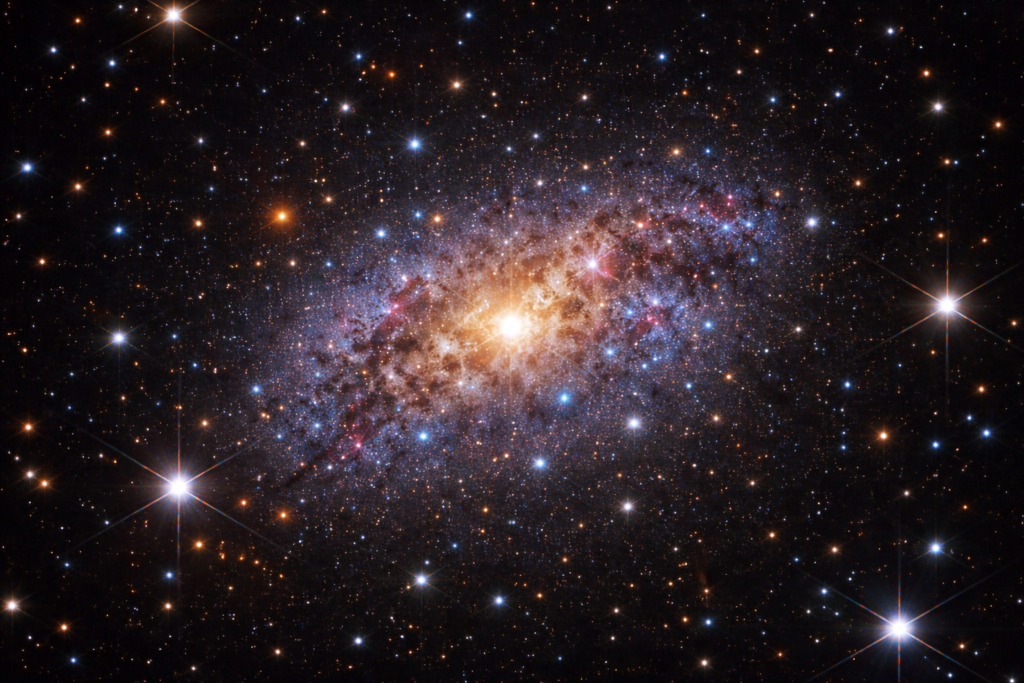
©Image PetsnPals/ChatGPT, Golden core of a distant galaxy

A faint galaxy spotted by the James Webb Space Telescope has turned into a serious challenge for astronomers studying the early universe. The object formed just a few hundred million years after the Big Bang, yet it already shows signs of chemical maturity that should have taken far longer to develop. That mismatch between age and development is pushing NASA scientists to reconsider how fast early galaxies grew, how quickly stars enriched their surroundings, and whether the first chapters of galaxy formation unfolded far more rapidly than models have assumed.

Read more

A Newly Observed Quantum Particle Is Challenging Long Held Theory

Physicists found a loophole in the usual rules.

©Image license via Canva

In early 2025, a team working at Brown University reported experimental evidence for an exotic quasiparticle called a fractional exciton inside a carefully engineered graphene device. It is not a free particle you can bottle, it is a collective behavior that appears only under extreme conditions, very low temperatures and very strong magnetic fields. Still, its existence and its strange quantum statistics are forcing researchers to rethink how neutral excitations are supposed to behave in some of the most correlated materials ever built.

Read more