
Something about this discovery feels out of place.
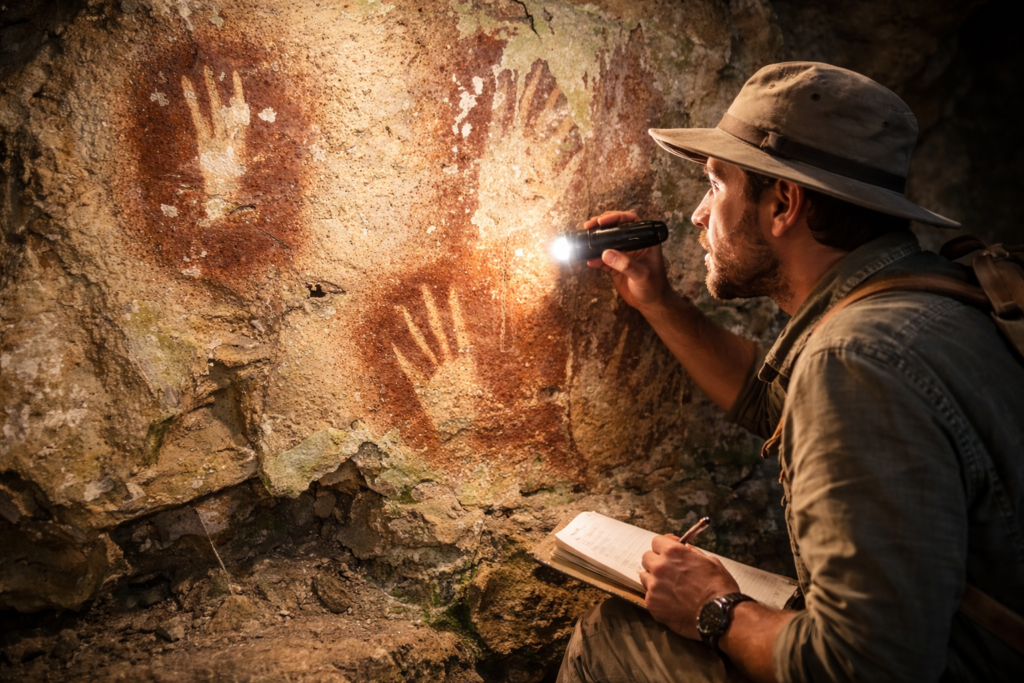
Deep inside a limestone cave on a remote Indonesian island, a fading imprint has begun to unsettle decades of certainty. It does not announce itself loudly. It lingers, barely visible, almost missed entirely. Yet researchers are now circling it with growing intensity, recalculating timelines that once felt settled. If this single handprint is what it appears to be, then something about early human expression did not happen when or where we thought it did. The more closely it is examined, the less stable the existing timeline appears, as if one faint mark is quietly pulling at the foundation of everything built around it.
1. Deep within the cave something older emerges.

The location alone complicates the story. Liang Metanduno cave on Muna Island sits far from the usual centers of early symbolic art. For years, attention stayed focused elsewhere, leaving places like this largely unexplored or underestimated.
Researchers identified reddish hand stencils on the cave walls that had faded into near invisibility. Dating methods now suggest these markings could be around 68,000 years old, pushing artistic behavior into a time period previously considered unlikely for such expression in this region.
2. A fading imprint refuses to stay forgotten.

The hand stencil itself does not command attention at first glance. Its pigment has thinned, its edges softened by time. Yet that very fragility raises a difficult question about how many similar markings may have already disappeared without record.
Scientists working on the site noted that the stencil’s survival is almost accidental, preserved under just the right conditions over tens of thousands of years. That fragile persistence hints at a much larger, mostly erased archive of early human expression.
3. Dating methods begin to stretch established timelines.

Pinning down the age of something this old is not simple. Researchers rely on uranium series dating applied to mineral deposits that formed over the pigment, offering a minimum age rather than an exact moment of creation.
The mineral layers suggest the stencil predates 68,000 years. That number matters because it challenges the assumption that complex symbolic behavior emerged later, or was confined to specific regions like Europe.
4. The island location complicates migration narratives further.

Muna Island sits off the larger eastern Indonesian island of Sulawesi, a region already known for ancient cave art. Still, each new find adds pressure to rethink how early humans spread and what they carried with them.
If people were creating symbolic markings here at this time, it suggests that artistic expression was not a late development that traveled slowly. Instead, it may have been embedded in early populations moving through Southeast Asia, long before reaching other parts of the world.
5. Early humans may have expressed ideas earlier.

For decades, the prevailing idea held that symbolic art appeared alongside cognitive leaps tied to later human groups. This stencil does not fit neatly into that narrative, arriving far earlier than expected.
That forces a reconsideration of when humans began to think in abstract, symbolic ways. It suggests that the capacity for expression may have existed long before it became widespread or visible in the archaeological record, raising the possibility that earlier evidence simply has not survived.
6. Similar discoveries nearby begin forming a pattern.
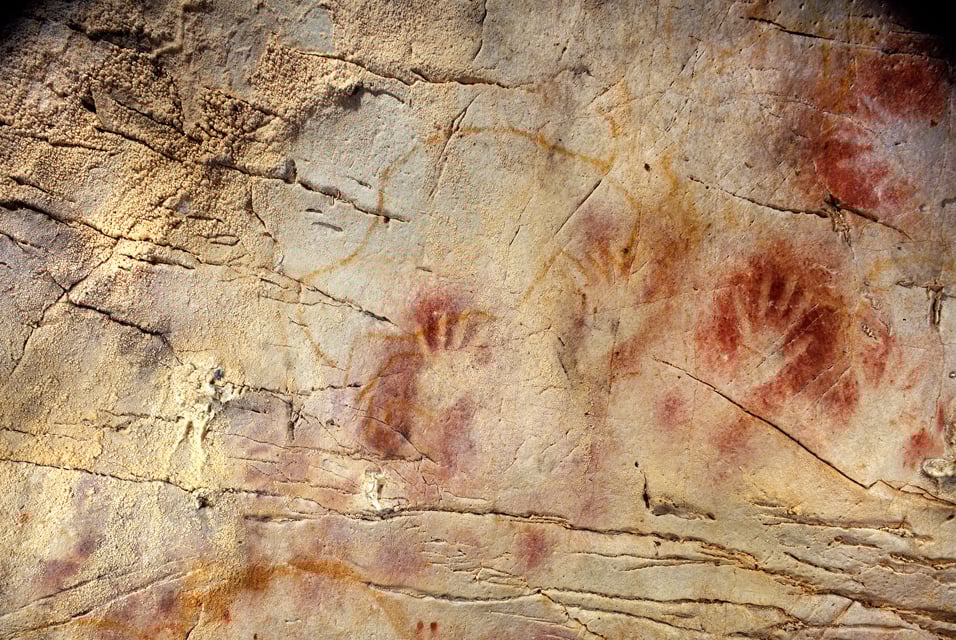
This is not an isolated anomaly. Other cave sites across Sulawesi have revealed ancient paintings and stencils, some dating back tens of thousands of years, gradually building a broader picture.
What once looked like scattered exceptions now begins to resemble a regional pattern of early artistic activity. The accumulation of these findings makes it harder to dismiss any single site as an outlier, instead pointing toward a deeper, more established tradition of expression.
7. Preservation conditions shape what history remembers.

The survival of this stencil is tied less to intention and more to environment. Factors like humidity, mineral deposits, and airflow determine whether pigment remains visible or disappears entirely.
That introduces a quiet distortion into the archaeological record. Entire chapters of human expression may have existed but left no trace simply because conditions were not favorable. What we see today may be only a fraction of what once covered cave walls across the region.
8. The simplicity of the mark carries weight.

A hand stencil might seem basic compared to later figurative art. Yet its simplicity is part of what makes it significant, representing a direct, intentional act of leaving a mark behind.
There is something deliberate in placing a hand against stone and blowing pigment around it. It suggests awareness, identity, and presence. Even without complex imagery, the act itself signals a form of communication that reaches beyond survival into expression.
9. Researchers are questioning long held assumptions again.

Each new piece of evidence forces scientists to revisit earlier conclusions. The timeline of human creativity has shifted before, but this discovery pushes it further than many expected.
It raises the possibility that symbolic behavior developed independently in multiple regions, rather than emerging once and spreading outward. That idea complicates a narrative that once felt clean and linear, replacing it with something more fragmented and uncertain.
10. What remains undiscovered may change everything next.
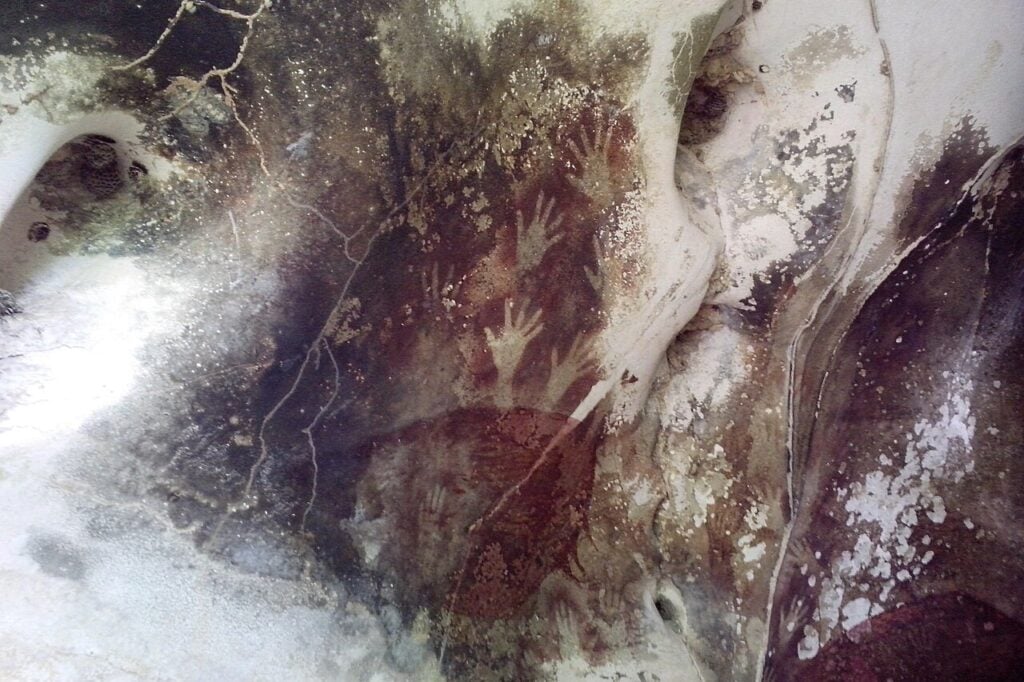
The cave walls of Southeast Asia have not been fully explored. Large areas remain undocumented, and advances in imaging technology are revealing markings previously invisible to the eye.
If one faint stencil can shift timelines this much, then others waiting to be found could reshape the story even further. The uncertainty is not fading, it is expanding, with each discovery widening the gap between what we thought we knew and what may still be hidden.