AI Therapy Is No Longer Sci Fi, 10 Ethical Shifts You Need to Know About

The support feels real, the rules lag.

©Image license via Canva

In 2024 and 2025, mental health chatbots and AI assisted coaching tools moved from novelty to routine, showing up in app stores, workplaces, and private late night searches. People use them for anxiety spirals, breakup grief, and everyday stress, often because a human appointment is expensive or weeks away. The ethical questions are no longer theoretical. They are about what happens when software becomes a confidant, what data gets kept, and who is responsible when guidance goes wrong.

Read more

If You Notice These Details Others Miss, You May Have Higher Awareness

Small signals add up faster than you think.

©Image license via Canva

In labs and everyday life, awareness is rarely one dramatic superpower. It is a steady skill built from attention, prediction, and noticing when reality does not match your brain’s quick shortcut. People who spot tiny shifts often do better at catching errors early, reading a room accurately, and staying calm during fast changes. Researchers link this to how attention is directed, how bodily signals are interpreted, and how flexible your mind stays under pressure.

Read more

Gen Z Is Living Online, and It’s Changing What Offline Means

Digital life is quietly redrawing everyday reality.

©Image license via Canva

For Gen Z, the boundary between online and offline no longer works the way it did for earlier generations. Phones are not a separate space, they are an extension of social life, work, identity, and even rest. What counts as being present has shifted, and so has the meaning of connection, privacy, boredom, and solitude. Researchers are now realizing that living online is not just a habit for Gen Z, it is reshaping how offline life is structured, valued, and experienced in measurable ways.

Read more

A Recent Discovery Is Forcing NASA to Rethink Early Galaxy Formation

A distant galaxy is breaking the expected timeline.

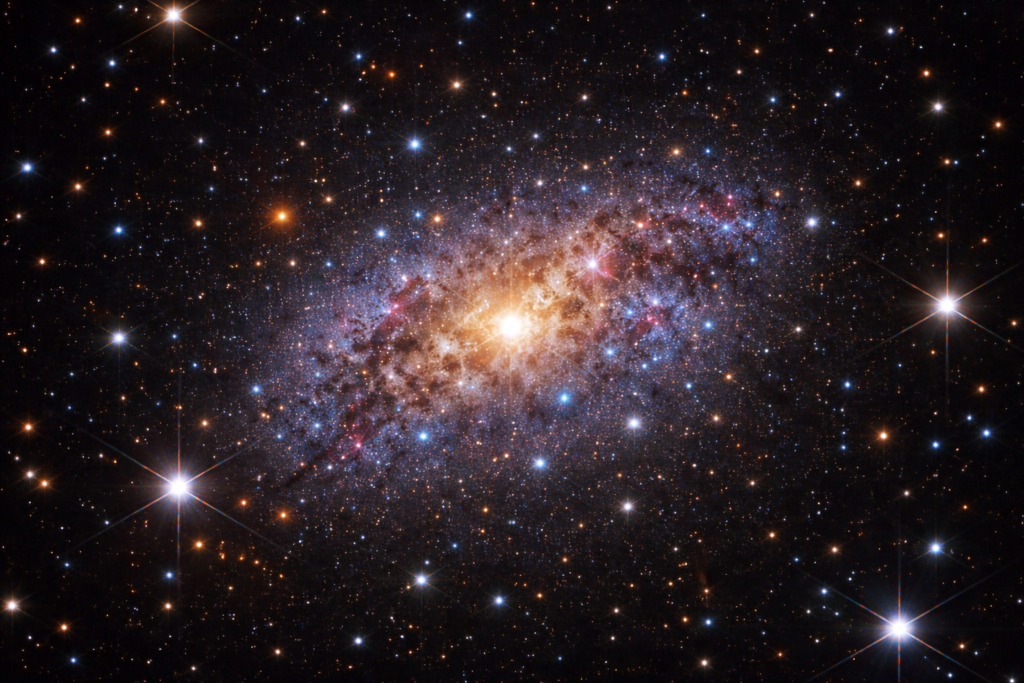
©Image PetsnPals/ChatGPT, Golden core of a distant galaxy

A faint galaxy spotted by the James Webb Space Telescope has turned into a serious challenge for astronomers studying the early universe. The object formed just a few hundred million years after the Big Bang, yet it already shows signs of chemical maturity that should have taken far longer to develop. That mismatch between age and development is pushing NASA scientists to reconsider how fast early galaxies grew, how quickly stars enriched their surroundings, and whether the first chapters of galaxy formation unfolded far more rapidly than models have assumed.

Read more

A Newly Observed Quantum Particle Is Challenging Long Held Theory

Physicists found a loophole in the usual rules.

©Image license via Canva

In early 2025, a team working at Brown University reported experimental evidence for an exotic quasiparticle called a fractional exciton inside a carefully engineered graphene device. It is not a free particle you can bottle, it is a collective behavior that appears only under extreme conditions, very low temperatures and very strong magnetic fields. Still, its existence and its strange quantum statistics are forcing researchers to rethink how neutral excitations are supposed to behave in some of the most correlated materials ever built.

Read more